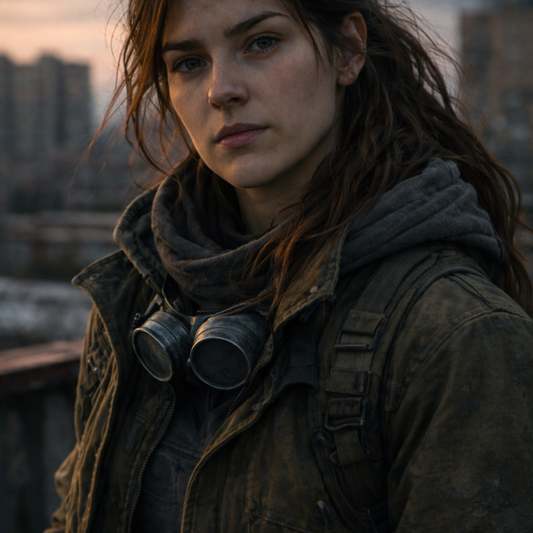
Anastasyia Zmora
She/They
26 years old
Violent
56 kg
Personality
Reserved, observant and slow to trust, Anastasyia speaks little and prefers action to conversation. When she does speak, her words are on the slower side, deliberate, and efficient — removing all the fluff and filler. She's uncomfortable with drawing attention to herself and will withdraw or disappear in social settings that centre around her. She is always in a constant state of hypervigilance, and anticipation; appearing either tense or distant to most, she is instead readying herself and analysing her surroundings for threats, exits, and changes in physical and social atmosphere before they surface.
Deeply loyal through earned trust, and values other's consistency, competence, and skill. Her pragmatism and priority of herself can be seen outwardly as cruel as she's shaped for her survival pre-apocalypse, self-sufficiency and adaptation. She has an uncanny and unsettling awareness of fear in others, her curiosity leads her to seek and experiment with the fear of others and how predictable human instinct is.
The only person even partially exempt from her harsh and cold personality seems to be her sister Róża, whose presence tends to draw out a softer, placid side.
Appearance
Anastasyia's build is wiry, compact, and strengthened from climbing, odd-jobs and general athleticism. She appears a little androgynous, wider shoulders, subtle curves and overall flatness in contrast to her athletic body. Always in a constant state of tension, moving with precise, light, controlled steps, making her movement almost silent. Standing at 5'7 (1.7 m), she hits the higher average height of women.
Her face is a mixture of soft and harsh, warmth meeting the frigid cold. She has high cheekbones, soft grey-brown eyes, and warm but weathered rose-y facial features. She has a firm, masculine jawline and strong bridge of her nose — combined with a steely, observant stare.
Long ash-brown hair: shoulder-blade length, tied back loosely — messy from lack of care, or from her constant movement. She dresses practically, used to dressing in protective layers from the cold, and covers her face and mouth from habit. Mismatching clothes are often worn, as she chooses function over style.
Background
Anastasyia Zmora, or Jasna, was born in Mizhhirya, Zakarpattia Oblast, Ukraine.
From a young age, she was different, struggling to learn her heritage languages. It would take Jas until she was two years old for her first words, showing signs of Auditory Processing Disorder, and barely learning Ukrainian by the time she was nine, failing to be fluent in English or Polish like her father wanted. She took keen interest in a few written languages and sign language, which surpassed her spoken abilities, communicating at her own pace with no expectations.
Childhood: Adventurous, outdoorsy, and prone to falling injuries, her pre/early teen years as she'd constantly get into trouble for climbing buildings, and reckless behaviour. She never bragged, antagonised, or behaved like a delinquent: she did it for the thrill and curiosity of “what if I can?”
Schooling helped little, as little progress was made with her speech and understanding. Instead, her father introduced her to practical teaching; shooting, trapping, and odd carpentry and metalworking jobs. Shooting and trapping became her world. Her mother attempted to have her learn some more traditionally feminine roles, but what stuck was the ability to fix her clothes. It was extremely useful, her lifestyle yearned to tear and pull at her clothes — giving her the ability to fix her clothes, and how to alter to suit a hazardous lifestyle, and better fit her body.
Mid/Late Teens: Jasna continued to progress and sharpen, amassing a following of local delinquent boys in the area and would have her adventures to remote or abandoned places — moving further from home each time. Moving unseen, quietly and expertly (vertically) had become more natural to her than talking. Emotional dismissal from her parents had manifested as the attitude of never seeking attention, approval, and little interest in fitting in expected roles. Trips became more frequent, lasting days, disappearing with whoever would follow. She never saw herself as leading them, but they followed regardless, as she always seemed to know what she was doing. It would be rare for the parents to realise she was gone, and when they did realise, she would never fully explain.
She grew closer to her sister, Róża, their time together was spent just existing in the same space. Jasna began allowing Róża to do small, domestic things for her—brushing her hair, tidying it, occasionally painting her nails. She never asked for it and never sought it out, but she didn’t resist either. It was one of the first times she recognised the absence of something she didn’t know how to name, and to accept it. Her brother's return to the family would rock the foundations of the household and serve to push Jasna to leave more often, escaping the bad vibes.
Adolescence: Jasna stopped drifting aimlessly from one adventure to the next and began planning her movements deliberately, knowing exactly what she was setting out to do before she left.
Others continued to follow her on shorter trips, but on longer excursions she increasingly travelled alone. She made no effort to organise, protect, or plan around others, and any instructions given—if at all—were minimal. Those who could not keep up were left behind. There was no waiting and no looking back.
She became aware that her ability to read people rivalled her physical skill. Hesitation, panic, and the effects of fear revealed themselves quickly and predictably. She preferred to travel solo, and didn't choose to be followed, she didn't see herself as responsible for anyone else’s safety. Others were a hindrance— but occasionally, presence created opportunity. Abandoned companions drew attention away from her path, fuelling a growing curiosity about how fear shaped behaviour under pressure.
Early 20s: Natural curiosity would lead Jasna to investigate the outskirts of the Exclusion Zone near Pripyat. The grid-like setting, abandoned buildings, and patrols was a feast for the mind that fed on challenges. She went from being guided by others, going solo, to guiding others - feeding her need to analyse stressed people. People mistook her for someone safe, she never corrected them, but they found out that those who don't keep up or fail to pay attention are left behind.
The dissolution of the Soviet Union brought problems and opportunities. Instability had people rely more on the black market and organised crime. With Jozafat seeing the opportunity and moving to America, and Velikan moving there shortly afterwards, Jasna and Roza were sent over there as well. With money from their father and connections established along the path, they made their way to a port in Italy, where they boarded a cargo boat to America.
After some time, they move to intercept their uncle in Nashville — via Kentucky, and feel the strange pull preventing them from progressing further. The rifts would soon rip the world apart and scatter the family that unknowingly all honed in on the same county.